SPECTRUM Wrap Up

Context and overall objectives
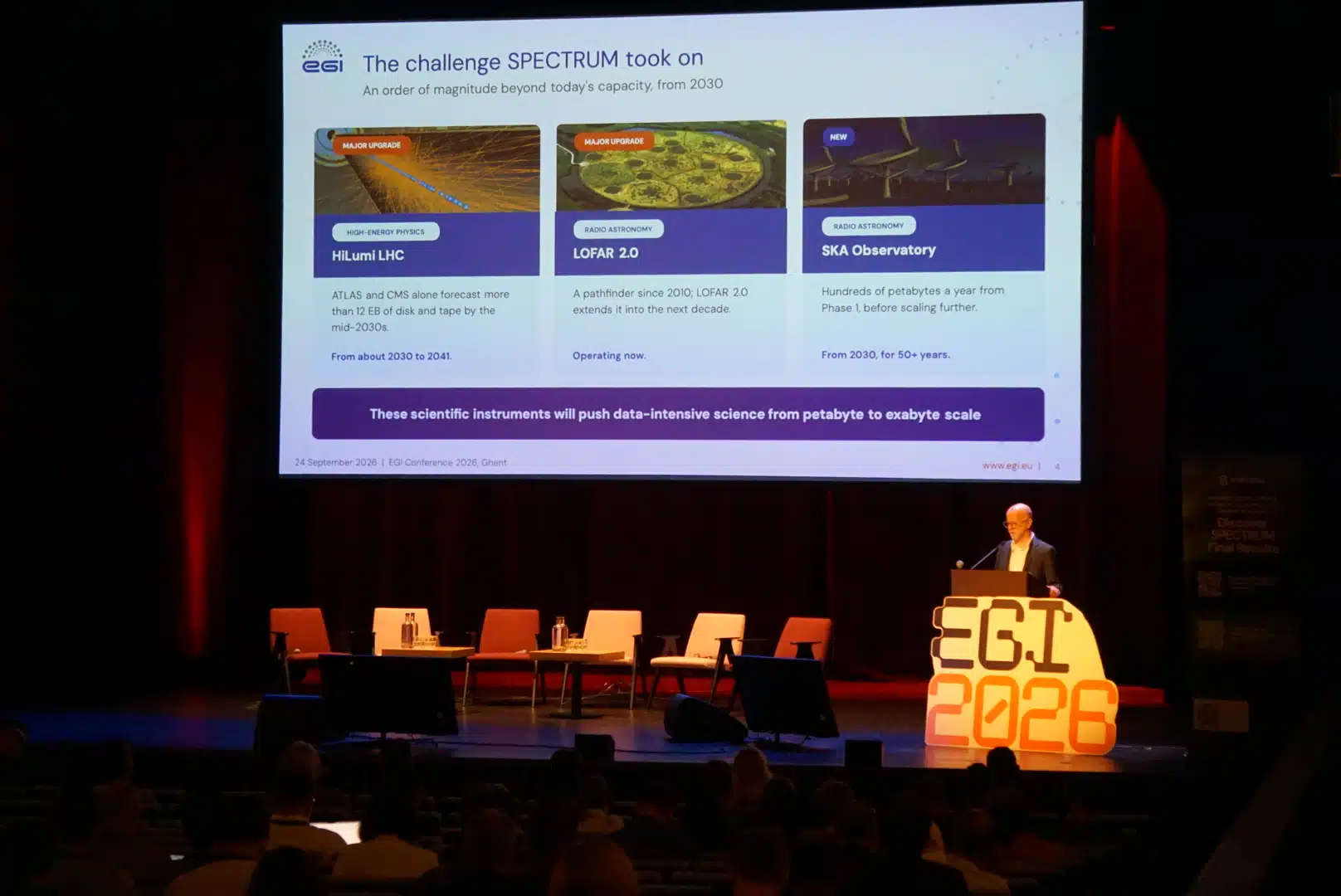
The amount of data gathered, shared, and processed in frontier research is set to increase steeply over the coming decade, leading to unprecedented data processing, simulation, and analysis needs. Research communities in High-Energy Physics (HEP) and Radio Astronomy (RA) are preparing to launch new instruments that require data and compute infrastructures several orders of magnitude larger than what is currently available, entering the Exascale era. Current infrastructures face limitations and bottlenecks that could hinder scientific discoveries unless unified and scaled.
To address these needs, this project developed a Strategic Research, Innovation and Deployment Agenda (SRIDA) and a Technical Blueprint (TB) for a European compute and data continuum, supported by an active Community of Practice (CoP).
By delivering these core outputs, SPECTRUM paves the way toward data-intensive scientific collaborations with access to a federated European Exabyte-scale research data federation and compute continuum. This ecosystem enables researchers to process and analyze data more efficiently, securing European scientific leadership and digital sovereignty.
Work performed and main achievements
The project completed all planned tasks across its 7 WPs, completing 15 deliverables, 12 milestones, and 6 Key Exploitable Results (KERs).
During the first half of the project, a consultation compiled early feedback from the CoP of compute continuum experts in HEP and RA (D3.1), a summary of relevant Use Cases with key learnings and needs (D5.1), a Landscape Analysis capturing key European research compute infrastructures (D5.3), and an analysis of their access policies (D5.2). The second half focused on consolidating the CoP (D4.1) and preparing the project’s two key output documents: the TB (D6.1) and SRIDA (D7.1).
Main achievements:
- KER1: Established and sustained SPECTRUMCoP. Defined a post-project sustainability model and Community Charter to maintain cross-domain collaboration. Engaged 115 distinct entities via expert interviews, priority workshops, public consultations, and feedback events.
- KER2: Compiled and analyzed 14 representative scientific use cases across HEP, RA, and adjacent fields to define functional requirements.
- KER3 & KER4: Evaluated 20 major EU e-Infrastructures to benchmark technical capabilities and formulate policy recommendations for federated access, identity management, and multi-year resource allocation.
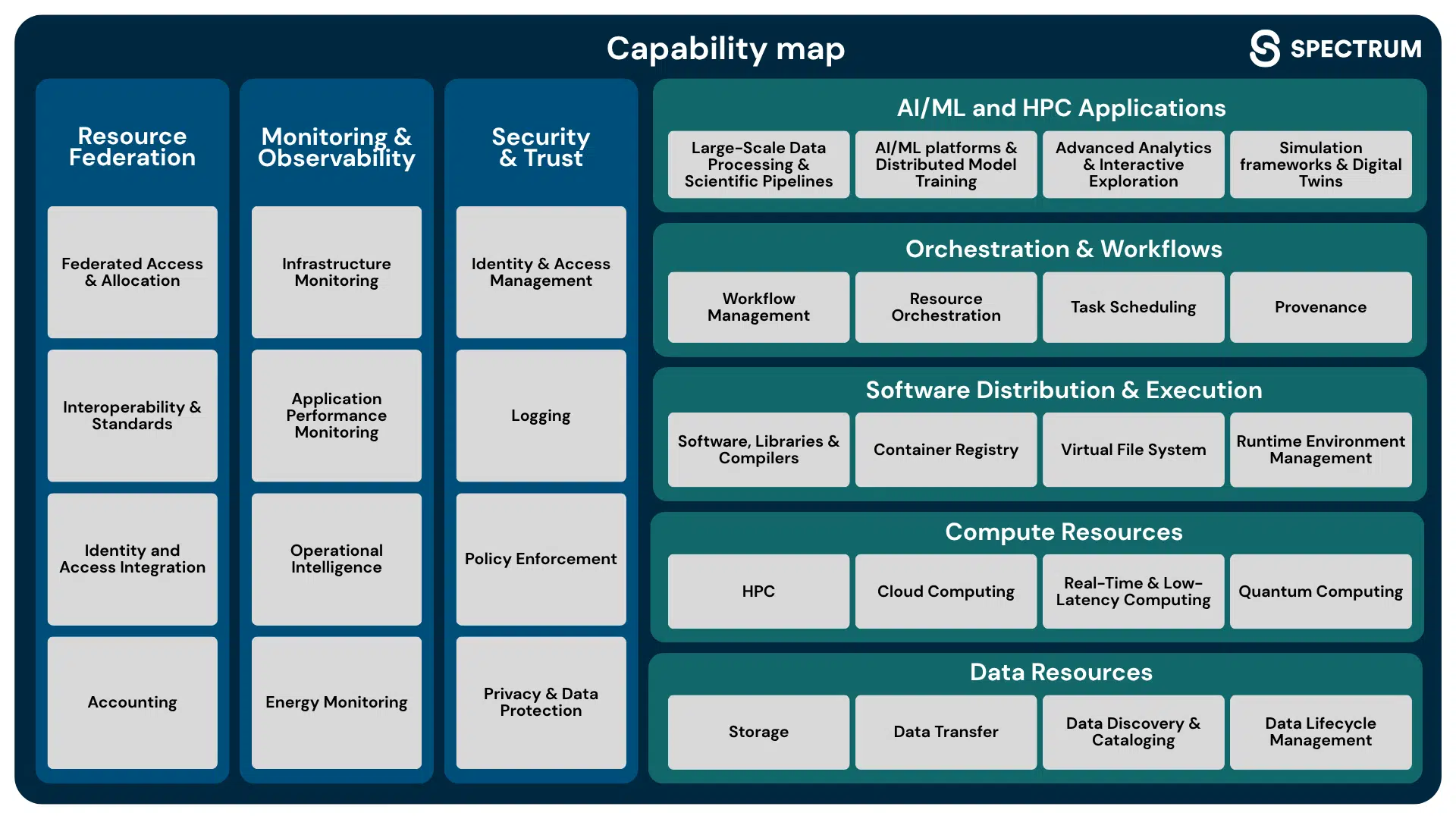
- KER5: Technical Blueprint. Established a functional Capability Map across 32 technical domains connecting HPC, High-Throughput Computing (HTC), Cloud, and Edge infrastructures. Defined functional specifications for cross-domain data orchestration, federated identity management, resource orchestration, and workflow engine integration across major European providers. Formulated architecture patterns to eliminate network bottlenecks, manage data lifecycles, and enable unattended multi-site execution.
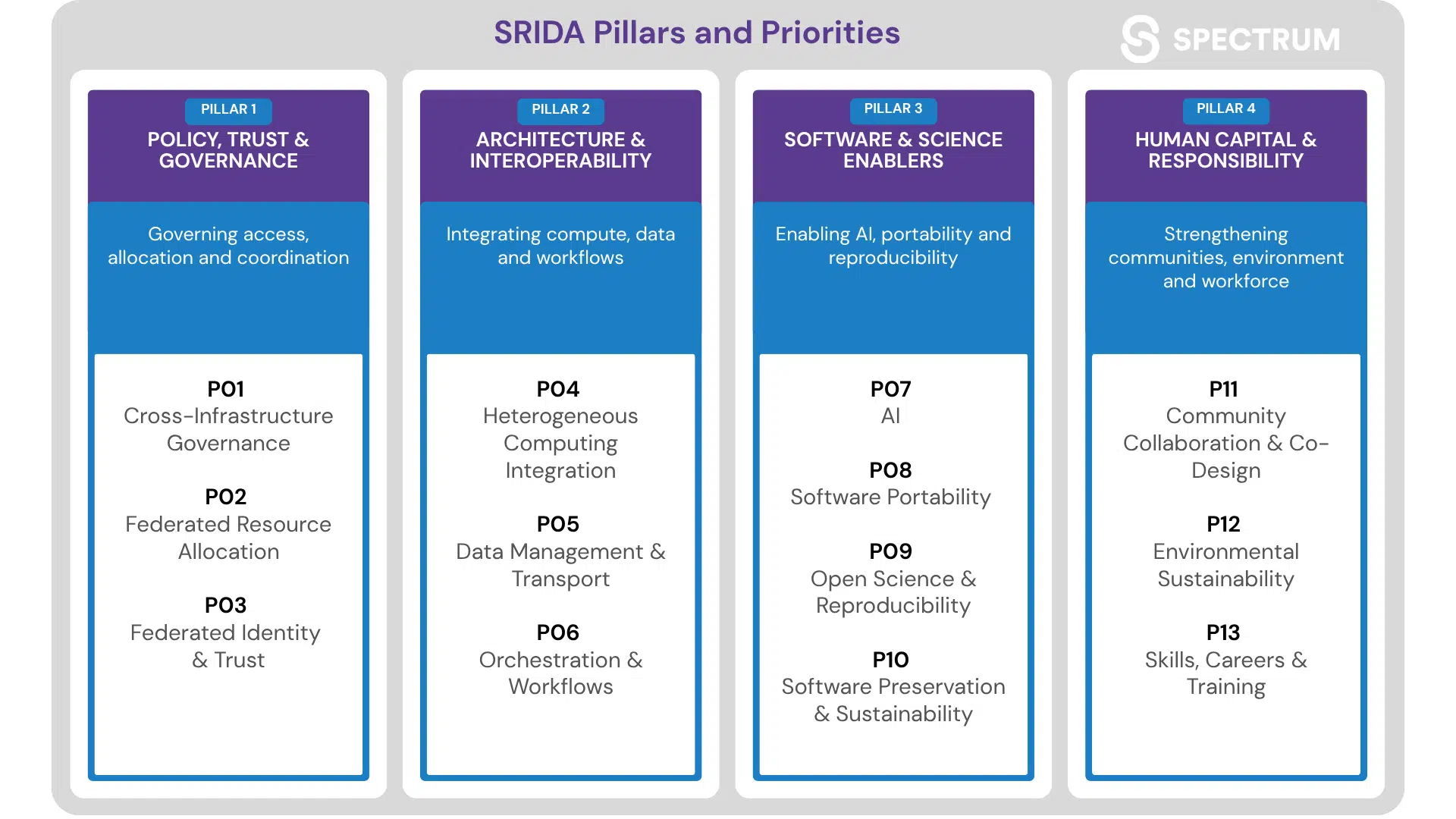
- KER6: Strategic Research, Innovation and Deployment Agenda (SRIDA). Delivered a multi-annual strategic roadmap structured around 13 priorities across 4 strategic pillars (Policy, Trust & Governance; Architecture & Interoperability; Software & Science Enablers; Human Capital & Responsibility). Identified 5 key investment areas (Computing Infrastructure, Data Infrastructure, Software & Tools, Governance & Coordination, Human Capital) and mapped priorities to EU funding frameworks.
Results
The consolidation of the CoP (KER1) and the deployment of the Knowledge Hub have created a collaborative space for sharing tools, methodologies, and technical solutions across scientific domains. Under a fruitful collaboration with the JENA Computing Initiative, a survey was conducted to understand current best practices and future needs in large-scale and data-intensive scientific computing in HEP and RA. The survey results (D3.1) contributed to the EU Strategy for Particle Physics. Over the project, the CoP consolidated as a meeting point for exchange driven by plenary meetings, expert interviews, consultations, and active participation in refining the TB and SRIDA.
The Compendium of Use Cases (KER2), together with the Landscape Analysis (KER3) and Access Policies compilation (KER4) in D5.2 and D5.3, represents the top-down vision of gaps and future needs for major scientific experiments in the next decade. These served as the foundation for building the TB (KER5) and SRIDA (KER6) documents.
The TB (KER5) outlines a framework for a EU Compute and Data Continuum integrating computational resources, data management systems, and orchestration into interdependent capabilities supporting large-scale scientific discovery. It establishes a functional Capability Map across 32 technical domains connecting HPC, HTC, Cloud, and Edge infrastructures. It defines functional specifications for cross-domain data orchestration, federated identity management, resource orchestration, and workflow engine integration across the major European e-Infrastructure ecosystem. This enables the science community to benefit from economies of scale, increased efficiency, and lower barriers to using large-scale computing resources, envisioning how infrastructures will be designed and operated in the coming decade.
The SRIDA (KER6) presents a coordinated EU strategy addressing exabyte-scale data, heterogeneous computing, federated access, AI adoption, environmental sustainability, and workforce development. The SRIDA identifies key investment areas and defines a phased implementation roadmap from near-term governance foundations to long-term operational maturity.
Adoption of these recommendations will enable next-generation experiments in RA and HEP to tackle their computing and data challenges while offering new opportunities across the supply chain to consolidate the European advanced computing sector.
Policy Influence
SPECTRUM outcomes contribute to developing, strengthening or improving EU research policy and digital investment priorities.
The TB and SRIDA provide funding bodies with an evidence-based validated investment roadmap, preventing fragmented infrastructure spending and promoting interoperable Exabyte-scale systems. Promotes open-source scientific software, FAIR data practices, and European data federation architectures, mitigating vendor lock-in and vendor export control risks. Aligns with the European Research Area Policy Agenda by offering policy recommendations for R&I career paths for Research Software Engineers, AI/ML integration in science, and cross-border resource federation.
The data and compute landscape is still scattered, requiring dedicated channels to build a common European voice to stay competitive. While initiatives such as EOSC and EGI have successfully facilitated interoperability across digital infrastructures, research infrastructures and scientific users for over a decade, FP10 must provide specific funding to consolidate horizontal digital infrastructure services. This will ensure European contributions to global collaborations remain competitive, federated, and capable of handling future exascale data challenges.