
Landscape of RIs: technologies, services, gaps
The technical landscape of 20 European e-infrastructures for HPC, high-throughput computing, cloud and data, set against the needs of high energy physics and radio astronomy, with recommendations for their evolution.
- Number
- D5.3
- Published
- June 2025
Lead partner: FZJ
This deliverable:
- Contains an analysis of the technical characteristics of 20 European e-Infrastructures in the areas of High-Performance Computing, High-Throughput Computing, Cloud Computing, and Data, which are open for use by European scientists
- Compares and contrasts them with the requirements of European research communities, in particular the High-Energy Physics and Radio Astronomy fields, with a focus on the use cases described in Spectrum Deliverable D5.1 (Representative use cases: analysis and alignment)
- Identifies and discusses recommendations for the future evolution of the e-Infrastructure landscape in Europe
Executive Summary
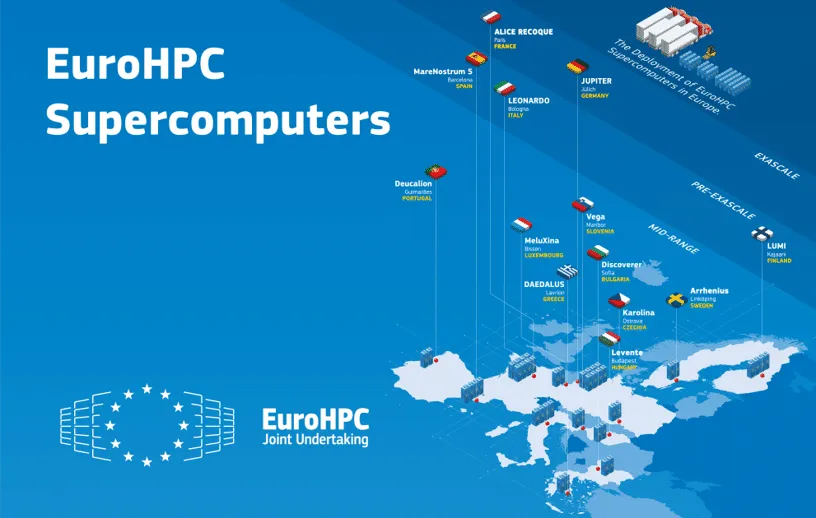
Radio Astronomy (RA) and High-Energy Physics (HEP) depend on fast, secure access to compute, storage, and data services distributed across Europe. The SPECTRUM D5.3 deliverable 1 maps the technical characteristics of 20 European e-Infrastructures – spanning High-Performance Computing (HPC) systems [with the EuroHPC Joint Undertaking 2 underpinning this landscape, establishing and sustaining the main HPC European-class ecosystem], High-Throughput Computing (HTC), Cloud e-Infrastructures, and data-oriented repositories – and compares them with RA/HEP needs and the use cases defined in Deliverable D5.1 3 . It also outlines recommendations for how this landscape should evolve.
The deliverable will serve as one of the inputs to the second phase of SPECTRUM (months 16-30) and eventually for the SRIDA and Technical Blueprint, to be delivered at the end of the project.
Why this matters
As instruments scale (from next-gen radio arrays to collider experiments), so do data volumes and workflow complexity. A clear, comparable view of which technologies and services exist – and where gaps remain – helps research teams plan robust pipelines, align access policies, and prioritize investments across federated resources. The SPECTRUM D5.3 report provides exactly that structured overview.
- Scope: A comparative analysis of 20 European e-Infrastructures open to European scientists.
- Domains: HPC, HTC, Cloud, and Data services, with attention to software stacks and federation aspects.
- Benchmark: Alignment with the RA/HEP communities and the requirements for use cases identified in D5.1 (Representative use cases: analysis and alignment) 4 and the SPECTRUMCoP (SPECTRUM Community of Practice) 5 to ground the analysis in real community needs.

Technical and operational requirements for future e-Infrastructures
SPECTRUM D5.3 derives technical and operational requirements for future e-Infrastructures:
- FAIR storage for observation/experiment data across domains.
- Take care in including GDPR and special category data.
- Automated, efficient data movement and data staging.
- Plan data transfer capacity according to research community requirements.
- Enable portability of compute tasks across accelerated compute platforms.
- Establish common workflow systems supported by all e-Infrastructures.
- Establish common SW stacks for compute applications.
Highlights and Implications for RA and HEP
- Technologies and services catalogued: Compute modalities, storage, data transfer, and software ecosystems documented uniformly.
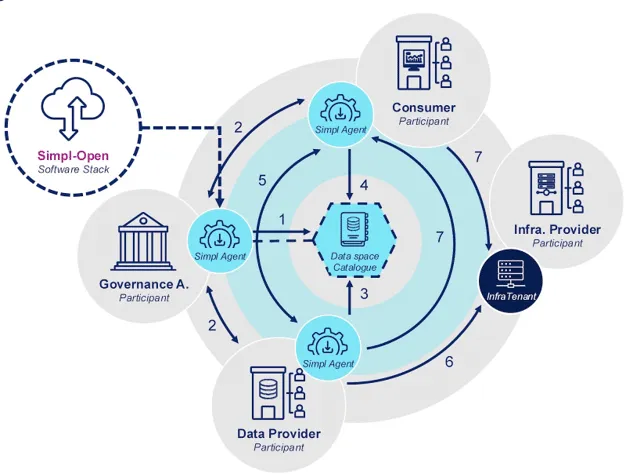
- Gaps identified: Current capabilities and policies gaps highlighted; harmonization/federation themes emphasized, such as Simpl (Smart Middleware Platform) 6.
- Actionable direction: Recommendations for evolving the European e-Infrastructure landscape to support data- intensive science.
Implications for RA & HEP
- Planning and portability: Teams can better plan workflows across heterogeneous sites.
- Policy alignment: Supports harmonization efforts to accelerate cross-discipline science.
- Sustainable evolution: Helps funders/operators target improvements benefiting multiple communities.
Read SPECTRUM D5.3 and share it with infrastructure leads and project PIs to inform resource planning and cross-site collaborations. This deliverable gives European science communities a strategic overview of e-Infrastructure capabilities and gaps, guiding how resources can evolve to meet the increasing needs of RA and HEP communities.