The Strategic Research, Innovation and Deployment Agenda (SRIDA) will define the vision, overall goals, main technical and non-technical priorities, investment areas and a research, innovation and deployment roadmap for data-intensive science and infrastructures. While the core focus will be on the challenges of HEP and RA, the project will validate proposed technical and strategic solutions with other data-intensive science cases to ensure that other disciplines with similar challenges can benefit from the project results.

The SPECTRUM Strategic Research, Innovation and Deployment Agenda (SRIDA) presents a coordinated European strategy for the compute and data continuum serving data-intensive science. Grounded in the requirements of High Energy Physics (including the HL-LHC programme and the WLCG) and Radio Astronomy (including the SKA Observatory and LOFAR), the agenda addresses challenges shared across data-intensive disciplines: exabyte-scale data, heterogeneous computing, federated access, AI adoption, environmental sustainability, and workforce development.
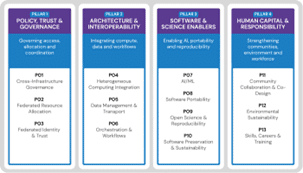
Thirteen strategic priorities are organised within four pillars: Policy, Trust and Governance; Architecture and Interoperability; Software and Science Enablers; and Human Capital and Responsibility.
The SRIDA identifies investment areas spanning computing and data infrastructures, software, governance, and human capital, and defines a phased implementation roadmap from near-term governance foundations through medium-term technical integration to long-term operational maturity.
The agenda builds on evidence from the following project deliverables: Technical Blueprint (D6.1), use case analysis (D5.1), landscape survey (D5.3), access policy analysis (D5.2), and community of practice (D3.1). The agenda is informed by structured community consultation and is intended to guide coordinated European action across scientific communities, service providers, and policy makers.
European data-intensive science is approaching a step change in scale. The instruments coming online over the next decade, including the High Luminosity Large Hadron Collider (HL-LHC), the SKA Observatory and LOFAR 2.0, will generate data volumes and processing demands an order of magnitude beyond current infrastructure capacity. The HL-LHC alone is projected to require tens of exabyte storage and tens of millions of CPU-equivalent cores from 2030 onwards; SKA Phase 1 will produce hundreds of petabytes per year before scaling further. These facilities operate on multi-decade timelines, so the architectural and governance choices made in the next five years will determine whether Europe can extract the scientific return on infrastructure investments already committed. Meeting this challenge requires coordinated action across scientific communities, computing and data service providers, and policy makers. This Strategic Research, Innovation and Deployment Agenda (SRIDA) presents thirteen priorities, five investment areas, and a phased multi-annual roadmap that turn that coordination into action.
Europe’s research infrastructure landscape combines EU-level coordination, through ESFRI for long-term research infrastructure planning, EuroHPC for supercomputing capability, and EOSC for federated data and open science, with national investments that still provide the majority of operational storage and computing capacity. This agenda builds on operational experience from federated infrastructures already coordinating nationally-funded resources at European scale: EGI for national and research institution computing facilities, WLCG for LHC-related computing/storage facilities, the SKA Regional Centre Network (SRCNet) and GEANT for the networking. These existing federations show what is feasible and where the next generation of coordination must reach further.
Seven drivers shape the strategic environment. Infrastructure Scale: flagship instruments will move from petabyte to exabyte operations, requiring architectural evolution across compute, storage, and networking, with heterogeneous accelerators (GPU, FPGA, DPU, and emerging quantum devices) becoming the default rather than the exception. AI Adoption: artificial intelligence is being adopted rapidly across the research data lifecycle, with most applications still moving from proof-of-concept to production and demand for AI-capable infrastructure growing across European research communities. Environmental Sustainability: energy availability, water use, and embodied carbon in hardware are becoming primary constraints on infrastructure growth, making efficiency a design parameter rather than an afterthought. Security and Trust: post-quantum cryptographic transitions, evolving authentication requirements, and stricter data governance frameworks add complexity to federated operations. Long-term Preservation: instrument timelines of 20 to 50 years require software, data, and AI models to remain usable across hardware generations, with FAIR principles extending to workflows and provenance. Workforce Capacity: skills profiles are shifting toward research software engineering, data engineering, and applied AI; career structures, recognition, and competition with industry for technical talent remain unresolved. Digital Sovereignty: European policy increasingly treats digital capacity as a strategic asset, requiring open technologies, data processing within European jurisdictions, and resilience against geopolitical disruption.
Responding to these drivers requires progress against five strategic goals: coherent governance connecting thematic research infrastructures with horizontal e-infrastructures; seamless resource access through multi-year allocation and federated authentication; technical interoperability across heterogeneous computing and cross-facility workflows; sustainability across software portability and environmental impact; and human capacity built on expertise combining domain science with computing skills.
The agenda organises thirteen priorities within four pillars to deliver these goals. Pillar 1: Policy, Trust and Governance establishes cross-infrastructure governance, multi-year resource allocation, and federated identity as foundations for everything that follows. Pillar 2: Architecture and Interoperability enables heterogeneous computing, federated data management, and cross-facility workflow orchestration. Pillar 3: Software and Science Enablers advances AI/ML in production, code portability and performance, scientific reproducibility, and the long-term preservation of data, software, and workflows. Pillar 4: Human Capital and Responsibility addresses community collaboration and co-design, environmental sustainability, and workforce development. The pillars are interdependent: technical interoperability without governance fails to scale, governance without skilled people cannot be implemented, and none of it is sustainable without explicit attention to environmental footprint.
Investment spans five areas: computing infrastructures, data infrastructures, software and tools, governance and coordination, and human capital. Open science and environmental sustainability cut across all five. Three categories are routinely underestimated and are essential for realising value from capital investments: coordination and federation costs, sustained software development beyond initial deployment, and long-term preservation of data, software, and workflows under FAIR principles. Effective investment depends on coherent action across EuroHPC, EOSC, Horizon Europe, the Digital Europe Programme, national research and infrastructure programmes, and operational funding for research infrastructures themselves.
Implementation follows three phases. The short-term foundation phase (1 to 3 years) establishes governance mechanisms, federated identity, and standardised interfaces, and begins co-design between thematic research infrastructures and e-infrastructures with the aim of aligning services and interfaces, not merging organisations. The medium-term integration phase (3 to 5 years) deploys heterogeneous computing capabilities at scale, federated data management, and workflow orchestration spanning HPC, HTC, cloud, and edge resources. The long-term maturation phase (5 years and beyond) achieves AI/ML at production scale, end-to-end reproducibility, and a stable career framework for research computing. Governance and identity foundations must precede technical integration; workforce development and environmental management run across all phases to keep the effort sustainable.
The agenda places concrete tasks on each stakeholder group. Scientific communities should publish multi-year resource plans, take part in co-design with e-infrastructures, identify high-impact use cases for moving AI/ML to production, and contribute to shared software and data stewardship. Service providers should establish formal liaison mechanisms with thematic research infrastructures, deploy federated identity and standardised interfaces, expose heterogeneous resources through common APIs, and provide training that allows researchers to use them efficiently. Policy makers should ensure that data-intensive science requirements inform EuroHPC and EOSC priorities, enable multi-year allocation across heterogeneous resources, fund/reward sustained software development and data stewardship as first-class activities, support career pathways for research software and data engineers, and set environmental budgets that infrastructure operators are required to meet.
The Technical Blueprint (D6.1) provides the architectural foundation; the SRIDA provides the strategic framework for investment, governance, and implementation. Together they chart the path toward a 2035 compute and data continuum where researchers move workloads across HPC, HTC, cloud, and edge resources with one identity, predictable allocation, and portable software, and where environmental footprint is measured and managed. The expected impact extends beyond the instruments that drove the agenda: a workforce skilled in research software and data engineering, European innovation in software, in advanced computing and energy-efficient hardware, broader public visibility of publicly funded science, and policy inputs on AI governance, digital sovereignty, and sustainable computing.